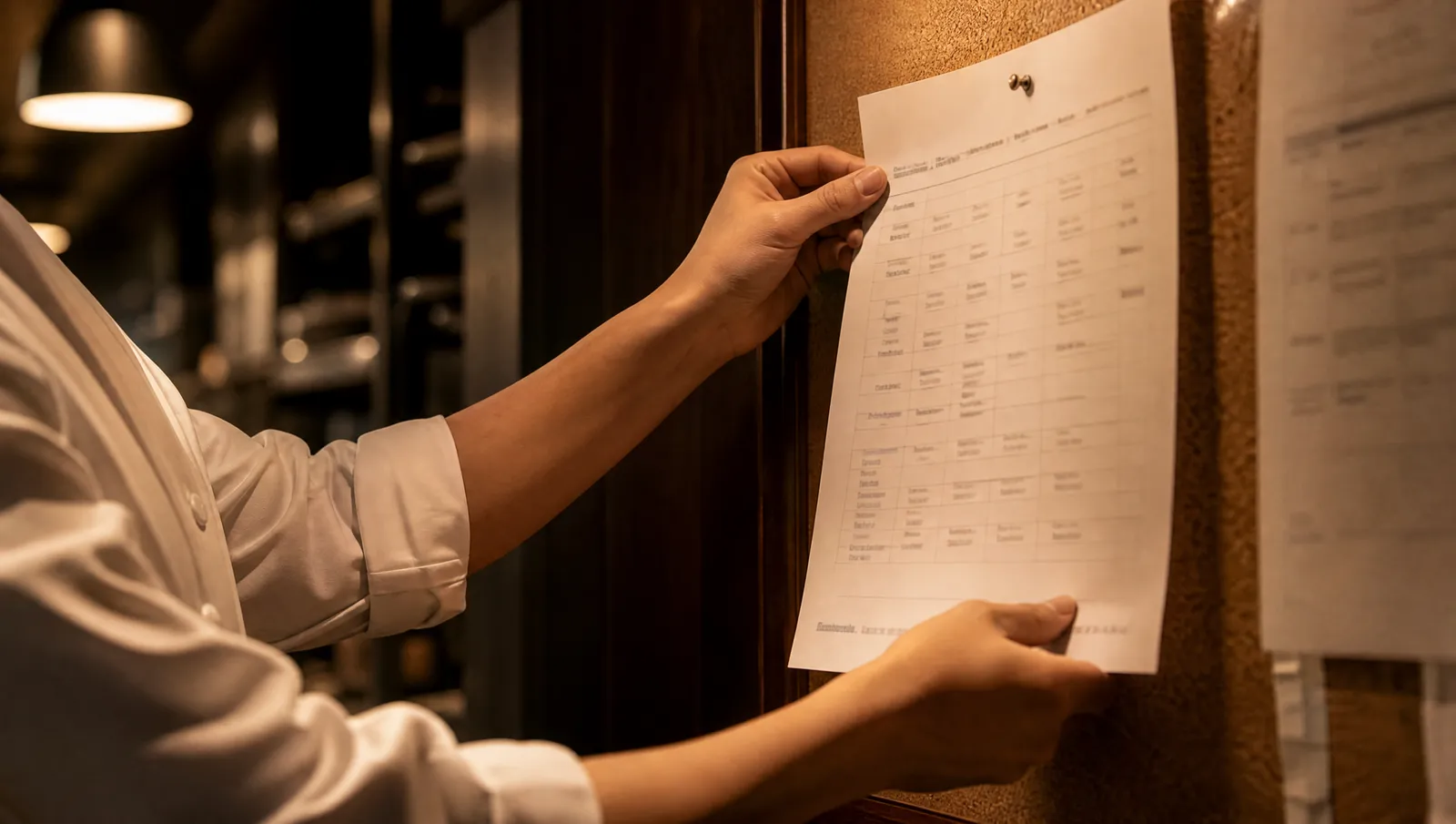
The situation
A four-week kitchen rota for two hotels
A hotel company runs kitchens in Prague and Dresden, each with about 25 cooks. Banqueting season means split shifts: breakfast and lunch, a gap, then dinner service until 23:30. Some cooks close at night and open breakfast the next morning.
The operations lead has the four-week rota in a spreadsheet and wants to know which shifts break the rules before the season starts. The hours go on the daily rest, the breaks, what counts as rest during a split shift and where each country allows exceptions.
What the research has to settle
The rules behind the answer
- Eleven consecutive hours, as a baseline
- The Working Time Directive requires a minimum daily rest of eleven consecutive hours per 24-hour period. The gap in a split shift does not make up for a short rest overnight, because the rest must be consecutive.
- Germany allows a shorter rest in hospitality
- German law lets hotels and restaurants shorten the daily rest by up to one hour, provided another rest period is extended to at least twelve hours within the period the law sets.
- Czech law permits shortening only in listed cases
- Czech labour law allows the daily rest to be shortened for adult employees in listed situations, with the time made up in the next rest. Whether a hotel kitchen falls within them is part of the check.
- Breaks and records
- Both countries require a break after a set number of hours worked. In CCOO (C-55/18) the Court of Justice held that employers must have a system to record each worker’s daily working time.
How it runs in azta
From the question to the document
The question, as you would type it
Hotel kitchens in Prague and Dresden. Some cooks finish dinner service at 23:30 and start breakfast at 07:00. Others work 07:00 to 14:00 and 18:00 to 23:00. Which patterns break the daily rest and break rules in each country, and what exceptions apply to hospitality?
You start with
A four-week kitchen rota for two hotels
- 01
Describe the shift pattern
Give the shift times, split shifts and late closes. azta searches the Working Time Directive, the Czech Labour Code and the German Working Hours Act.
Cited research· Free - 02
Check the exceptions in the statute
Open the provisions on shortened rest and breaks in the original language, with their in-force status.
Atlas statute reader - 03
Find the decisions on recording and rest
Ask how the courts treated split shifts and working-time records. azta summarises the Court of Justice and national decisions and links each one.
Case-law search - 04
Draft the rota rules
Ask for a one-page rule sheet per kitchen and a list of shift patterns to change. Edit it in Canvas.
Canvas · Ask azta· Pro You send
A rota check note with the rest and break rules and the shifts to change
What you get
A rota check note with the rest and break rules and the shifts to change
Rota rules · draft
Kitchen rotas, Prague and Dresden: rest and breaks
Close then open. A cook who finishes at 23:30 cannot start breakfast at 07:00 in either kitchen. In Dresden the rest may be shortened by up to one hour if made up later. That still means no start before 09:30. In Prague, unless one of the listed exceptions applies, no start before 10:30.
Split shifts. The afternoon gap is not daily rest. The eleven hours are counted from the end of dinner service to the start of the next shift.
Records. Both kitchens record start, end and breaks for every shift on the time system, not on the rota. The rota is checked against these rules before it is published each week.
Outcomes on your numbers
What azta is worth on this task
Pro pays for itself after
24 minutes a month
At €70 an hour, that is all the time Pro (€27 a month) has to take off your desk to cover its price.
Example figures. Replace them with your own.
- Hours back a year
- 22
- Capacity at your rate
- €1,512
- More rota checks a quarter
- 1.5
- Return on Pro
- 4.7×
- Research
- Drafting
- Your review
A scenario you set, not a promise. The hours that come back go to another client, or deeper into this one.
Want these numbers on your team’s real workload?
Book a demoSources azta searches here
- e-Sbírka
- Gesetze im Internet
- Rechtsprechung im Internet
- EUR-Lex · Curia
What stays with you
- The rota itself and the staffing decisions behind it.
- Collective agreements and works agreements, which azta does not hold.
- Recording the hours actually worked.
Frequently asked questions
- Can I upload the rota spreadsheet?
- Yes, on Pro. Upload the rota and ask azta to flag the shifts that break the rules, with the reason for each.
- Does it cover collective agreements?
- No. azta holds legislation, EU law and court decisions. Upload a collective agreement to have it read alongside the law.
- Do the rules differ for young workers?
- Yes. Both countries set stricter rest and break rules for young workers. Put their ages in the question and azta researches those rules.